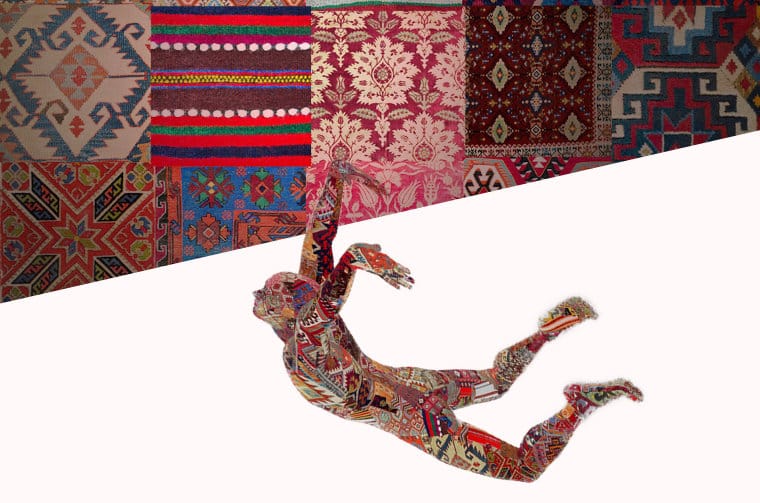
I am from there when I am here
Melih Nehat
04-07-2026 until 28-02-2027
Melih Nehat is a young Bulgarian artist of Turkish descent. His family was forced to move to Turkey during the late-communist “Revival Process” campaign. After the fall of the communist regime, they returned to Bulgaria. In his 20s, he lived in Turkey for a while. Melih speaks both languages fluently.
In English, we would say that Melih grew up between two cultures. The use of the word between implies a separation, as if the two cultures in Melih’s life are two solids that never touch or overlap, as if there is an empty space between them. And we position Melih right inside that void, as if to say that he belongs to neither culture.
In Bulgarian, we have two ways to talk about how Melih grew up. As in English, we can use “между” (between), but we can also use “с” (with). Growing up with two cultures, means one grew up accompanied by, equipped with, and made from two cultures. They are not walls on either side of you, but they are what made you.
In Turkish, one uses “arasında”, which can be translated as “between”, but also “among” or “in the midst of”. The space between cultures is itself a thing, a connective tissue or a relational space.
“Before, a long time ago, I did not find this odd. It was my normality,” Melih says now when he speaks about growing up between Bulgaria and Turkey. “Later, I understood that not everybody lives like me, between two cultures that have been at conflict for so long.”
“I am from there when I am here” shows a large scale human figure in a pose that resembles a bridge. The figure is covered in patterns taken from traditional Bulgarian and Turkish tablecloths, carpets, embroideries, and tiles. The act of combining these cultural markers into a single tapestry is an implicit postcolonial gesture. Ornamental traditions have historically been used to mark ethnic and national differences, to separate “us” from “them”. In the case of Bulgaria and Turkey, centuries of violence led to a wound even in today’s generation. Merging these patterns into a single skin inverts that logic by highlighting a shared visual grammar that resists nationalist and ethnicist purity narratives.
By using the figure of a body, “I am from there when I am here” becomes a home, a place of dwelling that connects and unites two cultures. It echoes Merleau-Ponty’s argument that we do not just have a body, but we are our body, and our body is how we inhabit the world meaningfully.
“This is personal,” Melih says, “It is a work of confidence rather than confusion. It does not ask permission to belong. It just represents what it feels to be both and to live happily in the in-between.”
Where most hybrid identity writing tends to be saturated with anxiety, “I am from there when I am here” performs an act of post-traumatic serenity. The historical conflict between Bulgaria and Turkey is acknowledged but not relived. The work claims synthesis without erasing the tension that made synthesis necessary. Its hybridity is not an academic concept but a hard-won survival strategy, which makes the work’s confident gesture all the more impressive.
Melih Nehat is a Bulgarian-Turkish designer and visual artist. He holds a bachelor degree in Interior design from Varna Free University, and participated in an exchange at Nisantasi University in Istanbul. His artistic practice includes design, installations, photography, and spatial concepts. Working across visual and spatial media, he explores identity, materiality, memory, transformation, and the relationship between objects, images, and context. His work is shaped by conceptual thinking, minimal forms, and a sensitivity to space, atmosphere, and visual presence. Alongside his artistic practice, he is part of a conceptual architecture and interior design studio.